
Solatube vs Flexible Light Tunnel: What’s the Difference?
If you’re looking for a way to bring natural daylight into a dark hallway, bathroom, kitchen, landing or other internal room, you’ve probably come across two main options: rigid daylight tunnels such as Solatube and flexible sun light tunnels.
At first glance, they appear to do much the same job. Both collect daylight at roof level and deliver it through the roof space to a diffuser in the ceiling below.
But there is an important difference.
The way daylight travels between the roof and the room can have a major effect on how much useful daylight reaches the space below.
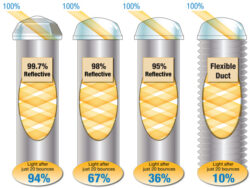
So, what’s the difference between a Solatube Daylighting System and a flexible light tunnel, and which should you choose?
What is a flexible sun light tunnel?
A flexible light tunnel normally consists of a roof-mounted dome or window connected to a ceiling diffuser by a flexible reflective tube.
The flexible material makes the tunnel relatively easy to route around obstacles in a roof space.
This can make flexible systems attractive where there are rafters, pipes, cables or other obstructions between the roof and the ceiling.
However, flexibility comes with a compromise.
The inside of a flexible tube isn’t perfectly smooth. The folds and changes in direction can cause light to be repeatedly reflected and scattered as it travels down the tunnel.
The longer and more complicated the route becomes, the more important this can be.
How is a Solatube different?
A Solatube Daylighting System uses rigid tubing with a highly reflective internal surface designed specifically to transport daylight efficiently.
Rather than simply creating an opening between the roof and ceiling, the complete system is designed around capturing, transferring and distributing daylight.
A typical Solatube system consists of:
- a roof-mounted daylight collector
- highly reflective rigid tubing
- engineered angle adapters where required
- a ceiling diffuser designed to spread daylight into the room
This allows daylight to travel surprisingly long distances and negotiate changes in direction while maintaining useful light output.

The tube matters more than you might think
This is probably the biggest difference between rigid and flexible daylight tunnels.
It’s easy to think of the tube as nothing more than a pipe carrying light from A to B.
It isn’t.
Every time light interacts with the internal surface of the tunnel, some of its energy can be lost. The reflectivity and geometry of that surface therefore matter enormously.
Solatube’s Spectralight® Infinity tubing has a spectral reflectivity of more than 99%, helping the system transfer daylight through the building with very low losses at each reflection.
This becomes particularly important when the distance between the roof and ceiling increases.
A short tunnel through a simple loft space is relatively straightforward. A longer tunnel through a deeper roof void, or one requiring offsets to reach the room below, places much greater demands on the reflective system.
That’s where a high-performance rigid tube can make a significant difference.
Rigid tube vs flexible tube
Imagine shining light down two passages.
One has smooth, highly reflective walls designed to bounce light efficiently along its length.
The other has a wrinkled surface with numerous small changes in angle.
Both will transmit light, but they won’t necessarily deliver the same amount at the other end.
That’s essentially the challenge with flexible daylight tunnels.
Their corrugated internal surfaces create many opportunities for light to be scattered rather than efficiently redirected towards the diffuser.
A rigid Solatube system provides a much more controlled optical path.
What happens when the light tunnel needs to bend?
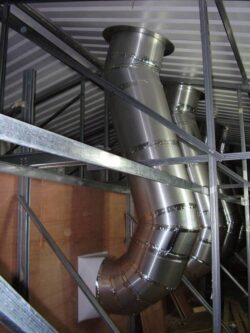
This is another area where people sometimes assume flexible tubing has the advantage.
After all, flexible tube can simply be bent around an obstruction.
Solatube takes a different approach.
Rather than bending the entire tube, engineered angle adapters can be used to change direction while retaining the highly reflective internal surface.
This allows us to route a Solatube around many roof-space obstacles while maintaining the optical performance of the system.
Good installation design is important. We always aim to create the most direct route possible between the roof and the ceiling diffuser.
What about cloudy Scottish weather?
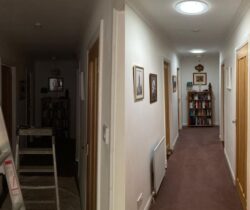
This is particularly relevant in Scotland.
A daylighting system can’t rely only on bright sunshine. It needs to make effective use of the diffuse daylight available from the sky on overcast days.
Solatube’s roof-level collector is designed to capture daylight and direct it into the reflective tube below.
That daylight is then transported through the system and distributed into the room.
This is why a well-designed daylight tunnel can still make a significant difference to an internal room on the kind of grey day we experience regularly in Scotland.
Of course, the amount of daylight entering any building will naturally vary with the weather, season, time of day, roof orientation and installation.
That’s exactly what natural daylight should do.
Is flexible tubing cheaper?
Flexible light tunnels can often have a lower initial purchase price and may be simpler to install in some situations.
If the only consideration is getting a daylight opening from the roof to the ceiling as cheaply as possible, that can make them attractive.
But we believe the more useful question is:
How much daylight will the system actually deliver into the room?
A daylight tunnel is normally installed because a room doesn’t receive enough natural light.
Its primary job should therefore be to deliver daylight effectively.
Saving money on the component responsible for transporting that daylight can be a false economy if the resulting room remains darker than expected.
What about long tube runs?

This is where we’d be particularly cautious about using flexible tubing.
As the tunnel becomes longer, maintaining light transmission becomes increasingly important.
The same applies where the route isn’t perfectly straight.
Solatube’s highly reflective rigid tubing means systems can be designed for applications where there is a significant distance between the roof and the room below.
This isn’t limited to houses.
We use the same fundamental daylight-transfer principle in commercial applications, where daylight may need to travel through much larger roof spaces to reach schools, offices, healthcare buildings, warehouses and other occupied spaces.
Which system should you choose?
There isn’t one answer for every building.
A short flexible tunnel may be suitable where budget is the overriding consideration and the roof-to-ceiling distance is small.
But if the objective is to maximise the amount of useful natural daylight entering the room, we would recommend a high-performance rigid tubular daylighting system.
That’s why at Solatube Scotland we install rigid Solatube Daylighting Systems rather than flexible daylight tunnels.
For us, the tube isn’t simply a connection between the roof and ceiling.
It’s part of the optical system.
Solatube vs flexible light tunnel: at a glance
Solatube rigid system |
Flexible light tunnel |
|
| Tube construction | Rigid | Flexible/corrugated |
| Internal surface | Highly reflective engineered surface | Reflective flexible material |
| Light path | Controlled | More scattered |
| Direction changes | Engineered angle adapters | Tube bends |
| Longer distances | Particularly well suited | Performance becomes increasingly important |
| Installation around obstacles | Planned rigid route and angle adapters | Easily routed |
| Initial cost | Typically higher | Often lower |
| Primary focus | Daylight performance | Simplicity/flexibility |
Don’t just compare tunnel diameters
If you’re comparing daylight tunnels, don’t assume two systems with similar diameters will produce similar results.
Look at the complete system:
How does it collect daylight?
How reflective is the tube?
How does it deal with bends?
How far does the daylight have to travel?
How is the daylight distributed into the room?
Ultimately, you’re not buying a piece of tube.
You’re buying the daylight that arrives at the other end.
Thinking about bringing daylight into a dark room?

Solatube Scotland supplies and installs Solatube Daylighting Systems throughout Scotland.
We can look at the room you want to brighten, the roof construction and the route between them and advise on the most appropriate Solatube daylight system and installation.
Whether it’s a dark hallway, internal bathroom, kitchen, utility room, landing or a much larger commercial space, the objective is the same:
Capture daylight at roof level and deliver as much of it as possible where it’s actually needed.
Contact Solatube Scotland to discuss your project or request a quotation.